The One Thing Your Creative Space Needs: A Sense of Separation

Every creative person has a favorite story about stumbling onto a great idea in the middle of nowhere. The musician who wrote their best song while waiting for a bus. The painter who sketched an entire series on a napkin in a diner. These stories make us believe that creativity is something that happens by accident, that you just have to be ready to catch it wherever it lands. But if you look closer at the people who produce consistently, something else emerges. They aren’t waiting for lightning to strike. They are building little worlds where lightning is more likely to hit. The most effective creative spaces share a single quality that most people overlook: a clear sense of separation from the rest of life.
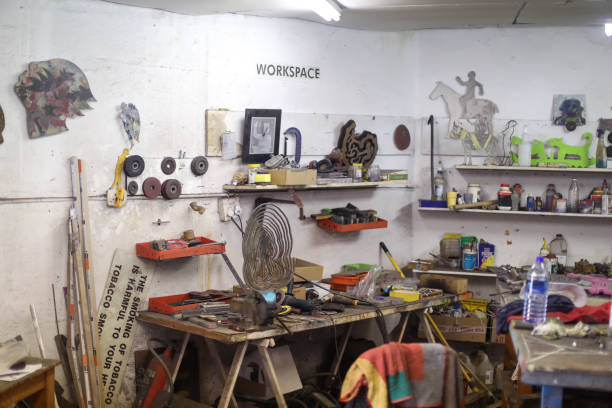
Think about the places where you do your best mental work. Maybe it’s a corner of your bedroom with a specific chair. Maybe it’s a desk in a basement. Maybe it’s a bench in a park that you visit every Tuesday. What do these places have in common? They are not the same place where you eat dinner, watch television, or argue about bills. Even if the physical distance is only a few feet, the psychological distance matters enormously. When you step into that designated space, something in your brain shifts. It recognizes the cues—the lighting, the smell, the arrangement of objects—and decides that this is the time and place for a certain kind of thinking. Over time, that association grows stronger. The space itself becomes a trigger.
This is not about having a fancy studio or a sprawling office. It is about creating a line that separates your creative work from your everyday life. For a writer I know, that line is a single floor lamp. When she sits under that lamp, she writes. If she sits anywhere else in her apartment, she does everything else. The lamp cost twenty dollars at a thrift store. But that small ritual of turning it on and sitting beneath its light tells her brain, “We are in creative mode now.” One graphic designer I spoke with uses a three-panel folding screen he built from scrap lumber. He slides it into place around his desk every morning. When it is up, he works. When it folds down, he is free to do laundry or pay bills. The screen is not about privacy. It is about a boundary.
A sense of separation works because it solves a problem that creative people face constantly: the pull of everyday distractions. When your creative space is also your dining table or your living room couch, the boundaries are blurry. You sit down to sketch, but the stack of mail is right there. The television is in the corner. Your phone is on the coffee table. Every object in the room is a potential competitor for your attention. Even if you resist, your brain is spending a small amount of energy fighting those temptations. That energy is better spent on the work itself. When your creative space is clearly separated—even if it is just a corner with a curtain—those distractions are physically out of sight. And what is out of sight becomes easier to keep out of mind.
Another reason separation matters is that it gives you permission to be unfinished. Creative work is messy. It involves false starts, half-baked ideas, and ugly early versions of what will eventually become something good. When you work in a shared or multipurpose space, there is pressure to clean up, to put things away, to appear productive even when you are just experimenting. That pressure kills the kind of playful exploration that leads to breakthroughs. A designated creative space, especially one with a door or a visual barrier, allows you to leave a half-finished canvas on the easel, or a pile of notes on the desk, without feeling like you have to explain yourself to anyone. You can walk away and come back tomorrow without losing momentum.
The physical details of the space matter less than the intention behind it. Some people need silence. Others need noise. Some work best in bright white light, others under a single warm bulb. The shape of the room, the color of the walls, the furniture—none of that is as important as the fact that you have drawn a line between here and everywhere else. The act of designating a space says something to your own mind: this is the place where I am allowed to think differently. That permission is the real engine of creativity.
If you do not have a separate room, look for ways to create separation with objects. A rug that you only step onto when you are working. A specific chair that you do not sit in for anything else. A hat you put on when you begin. A sign that you hang on the door handle. The goal is to build a ritual around the entrance and exit of your creative space. Over time, that ritual will do more for your output than any fancy desk ever could. The space becomes a container for your attention, and attention is the raw material of every creative act.
Articles