Why Your Next Creative Breakthrough Might Come From a Hotel Lobby
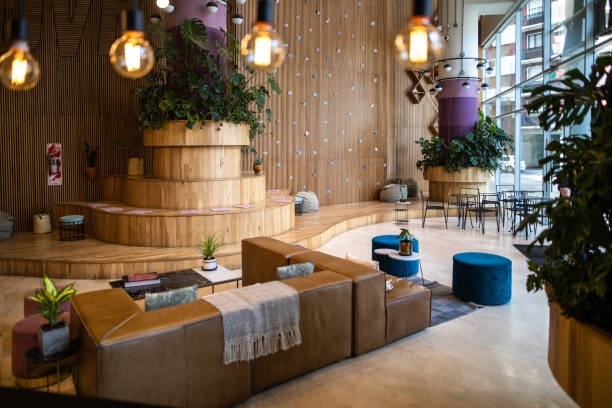
Most people think of a hotel lobby as a place you pass through on the way to a room or a bar. But if you are trying to jolt your brain into a more creative state, that same lobby can be one of the best temporary work spaces you have never considered. The trick is not about comfort or quiet. It is about the subtle signals your brain picks up when you place yourself in an environment designed for transience, a place where nobody really knows you and where the furniture is arranged for strangers.
When you sit down in a hotel lobby with your laptop, you are immediately surrounded by a collection of small, unfamiliar details. The carpet pattern is not your own. The lighting is neither the harsh overhead glare of an office nor the soft glow of your home desk. The air smells like fresh coffee mixed with a faint trace of cleaning solution and the floral arrangement on the side table. Every one of these sensory inputs is something your brain has not yet learned to ignore. And that is the point. Your brain, when placed in a truly new space, fires up a mild, low‑level alertness. It scans the room for danger, for interesting objects, for exits, for anything out of the ordinary. That scanning process keeps your mind from slipping into the comfortable rut of routine thinking.
In your usual workspace, your brain has already built a mental map. The squeaky drawer, the angle of the window light at 2 p.m., the sound of the refrigerator kicking in – all of that becomes background noise because your brain deems it safe and predictable. That safety is good for focused, repetitive tasks like data entry or paying bills. But it is terrible for creative work, which relies on making new connections between old ideas. A brand new space forces your brain to stay flexible. It cannot autopilot through the environment, so it stays looser, more open to the accidental connection. That is why so many writers, designers, and product people will tell you that their best ideas came not from a silent desk but from a noisy café or a park bench. The hotel lobby takes that logic one step further by adding the element of the temporary.
A hotel lobby has a built‑in time limit. You are not supposed to live there. You might stay for an hour or two until your room is ready, or you might camp out for a morning while you wait for a meeting. That sense of an ending does something interesting to your brain. It creates a mild pressure that bypasses the kind of anxiety that stops you from starting. You know you have a finite window, so you stop perfecting the first sentence and just write it. The same phenomenon happens when you work in a coffee shop, but the hotel lobby offers a different social energy. In a café, the staff and regulars are there every day. There is a community, a sense of belonging. In a hotel lobby, nobody belongs. Everyone is just passing through. That anonymity can be liberating for creative work. You do not feel like you are being watched by someone who might judge your work. You are a face in a crowd that keeps changing.
There is also the matter of the furniture. Hotel lobbies are designed to make you feel comfortable but not too comfortable. The armchairs are plush enough to sit in for an hour, but they are not your sofa. You do not have the temptation to lie down or fall asleep. The tables are sturdy but small, forcing you to keep your workspace minimal. This kind of constrained comfort is a friend to creativity. It gives you the physical ease to stay focused without the sprawling clutter that can undermine your momentum. And because the space is not yours, you have no instinct to tidy up or reorganize. You simply set up, work, and pack away. The entire process becomes a ritual that signals to your brain: “This is a work session, not a continuation of daily life.”
If you want to try this yourself, you do not need to check into a hotel. Walk into the lobby of a decent business hotel in your city. Find a corner table away from the front desk. Buy a coffee from the lobby café if there is one, or just sit politely. Most hotel staffs are used to guests and non‑guests mingling in the lobby, especially during the day. You will likely get nothing more than a curious glance. The important thing is that you go with no expectations. You are not there to have a breakthrough. You are there to give your brain a new set of walls, a different ceiling height, and a soundtrack of echoes and muffled conversations that it cannot predict. After thirty minutes, you may find yourself writing things you would never write at your usual desk. And that is the whole point of changing your environment.
Articles