The Unseen Potential of Clay: Molding Your Way to Creative Breakthroughs
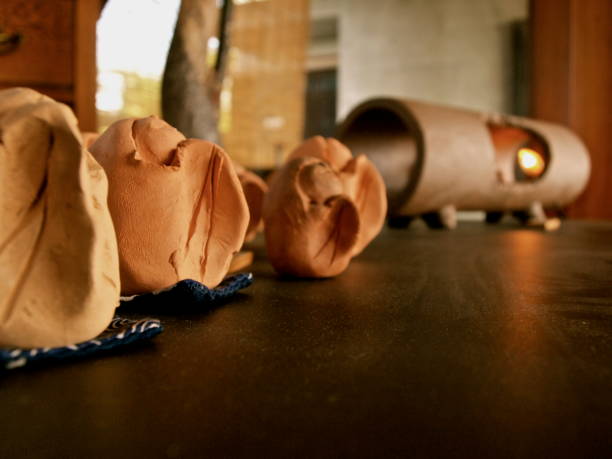
When was the last time you got your hands truly dirty? Not the quick wash of garden soil or the ink smudge from a pen, but the deep, cool, yielding press of wet clay against your palms. For most creative professionals, the daily routine involves screens, keyboards, styluses, and smooth paper. The world of digital creation is clean, precise, and predictable. But predictability is the enemy of original thought. If you want to shock your brain into a new register, consider setting aside the tools of your trade and sinking your fingers into a lump of raw, living earth.
Working with clay is one of the most direct tactile experiences a person can have. Unlike drawing, where the hand translates an idea onto a flat surface, clay forces you to think in three dimensions from the first touch. There is no undo button, no layers panel, no Ctrl+Z. The material pushes back. This resistance is not a flaw—it is a teacher. When you press your thumb into a clay ball, the clay presses back with a force proportional to your own. You feel the weight, the moisture, the grain. The feedback loop is immediate and physical. Your brain has to solve problems in real time: How do I make this wall stand? What happens if I add too much water? How do I convey the texture of bark or the curve of a shoulder without a single line?
This shift from visual to haptic thinking is a powerful catalyst for creativity. Most of us spend our days processing the world through sight and sound. Our hands are underused. But the human hand has an extraordinary number of nerve endings, and when we engage them in complex, varied tasks, we activate parts of the brain that remain dormant during passive observation. The act of squeezing, rolling, pinching, and sculpting sends a flood of sensory information to the motor cortex and beyond. It forces the mind to slow down, to attend to minute details, and to tolerate imperfection. Clay does not care about your intentions. It cracks, slumps, or dries too fast. To work with clay is to negotiate with an unpredictable partner. That negotiation builds mental flexibility.
Another way clay sparks creativity is through the phenomenon of accidental discovery. In digital work, mistakes are often erased immediately. But in clay, a slip of the finger can create an interesting groove. A lump that won’t smooth out becomes a texture. A collapse turns into a form you never planned. These accidents are not failures—they are invitations. The best creative ideas rarely come from following a blueprint. They come from responding to what the material offers. By working with a medium that has a life of its own, you train yourself to see opportunity in the unexpected. You become less attached to your original vision and more open to what emerges. That ability to pivot is essential for any creative career.
The physicality of clay also has a grounding effect. It is difficult to ruminate on a deadline or rehearse a difficult conversation when both of your hands are coated in slick, heavy mud. The tactile demands pull you into the present moment. This presence is a form of mental reset. When you step away from the wheel or the workbench, your mind often returns to other problems with fresh eyes. The act of making something with your hands, without the pressure of producing a finished piece, clears the psychic clutter. You are not trying to create a masterpiece. You are simply exploring the possibilities of a material. That low-stakes exploration is the perfect breeding ground for insights.
Finally, clay offers a lesson in transformation. A lump of gray, shapeless mud can become a bowl, a sculpture, a tile, a vessel that holds light or water. That journey from formlessness to form is a powerful metaphor for the creative process. It reminds you that every idea starts as raw, messy potential. The confidence to begin comes from the knowledge that shape can always be changed. You can smash it down and start over. Clay forgives. It teaches that nothing is final until you fire it in the kiln. Until then, everything is revision.
So next time you hit a wall on a project, walk away from your desk. Find a potter’s studio or even buy a box of water-based clay from an art supply store. Sit down with no plan. Just press, pull, and let the material guide you. Your hands will remember what your brain has forgotten: that creativity lives not in theories or apps, but in the simple, ancient act of touching the world and shaping it.
Articles