The Unseen Geometry of a Coffee Cup
Pick up an ordinary coffee cup. Not the fancy artisanal mug with the glaze that looks like a nebula, but the plain white ceramic one from the diner. The one you have used a hundred times without really looking. Now hold it at eye level. Tilt it slightly. Notice how the rim, which you know is a perfect circle, becomes an ellipse. The handle, once a simple loop, now appears as a twisted ribbon of light and shadow. This is the first lesson in observing with an artist’s eye: nothing is what it seems, and everything is geometry waiting to be discovered.
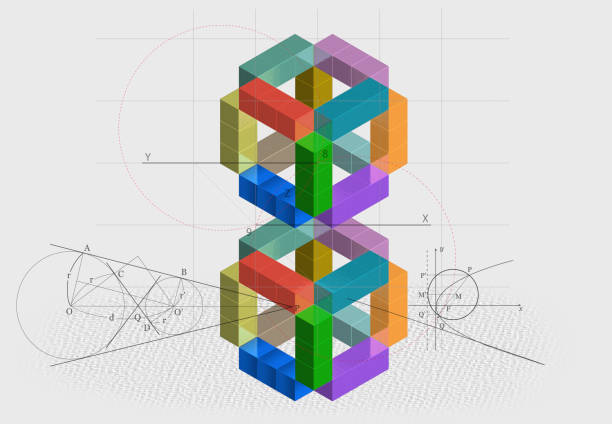
The artist sees the world not as objects with names and functions, but as relationships between shapes, lines, and spaces. When you start to look for these relationships, your brain switches from automatic recognition into active problem-solving. That coffee cup becomes a cylinder intersecting a torus, with an ellipsoidal opening at the top. The shadow it casts is not a fuzzy gray patch but a stretched pentagon with softened corners. The highlight along the glaze is not a glare to ignore but a sharp white curve that defines the volume. This shift in perception is the raw material for creative thinking because it forces you to break down complex scenes into simple parts, then recombine them in new ways.
Begin with negative space. Instead of looking at the cup, look at the air around it. The gap between the handle and the body is a shape with its own character—maybe a distorted teardrop or a slender kidney bean. Every object produces these counter-shapes, and they often have more visual interest than the object itself. Painters and photographers use negative space to balance compositions. But you can use it to generate ideas. When you are stuck on a problem, ask yourself what is not there. The empty space around a solution often reveals constraints or opportunities you missed.
Next, train your eye to find repetition. The coffee cup has a vertical axis. The handle mirrors the curve of the opposite side. The rim echoes the base in a smaller, reversed scale. Repetition gives structure, and structure gives you a foundation to play with. If you see the world as a network of repeated motifs, you can borrow a motif from one context and drop it into another. That is how a jazz musician takes a phrase from a bird song and turns it into a melody, or how a graphic designer adapts the spiral of a seashell for a logo. The artist’s eye is constantly cataloging these patterns.
Now introduce the element of light. Look at the same coffee cup under different lighting conditions. At noon, the shadow is short and harsh, carving a dark outline on the table. At dusk, the shadow stretches and softens, blurring into the surface. The highlights shift from the top rim to the side. This is not just a physics lesson; it is a creativity exercise. Every change in light changes the story of the object. A tilted cup under a desk lamp can look like a monolith under a desert sun. A cup in a dim room with a single candle can become a secret vessel. By observing how light transforms form, you learn that context is everything. Change the lighting of a problem, and you change the possible answers.
Finally, pay attention to the imperfections. The coffee cup may have a tiny chip on the rim, a slight wobble on the table, or a fingerprint smudged on the glaze. These flaws are what make the object unique. An artist’s eye does not edit them out; it highlights them. A broken line can be more interesting than a perfect one. An asymmetrical shape can feel alive. In creative work, the pursuit of perfection often kills novelty. By training yourself to notice and even celebrate irregularities, you open the door to unexpected solutions. The chip in the mug might inspire a design for a handle that fits the hand better. The wobble might lead to a new way to stack cups.
To practice this, pick a new object each day—a spoon, a shoe, a leaf. Spend five minutes drawing it with your finger in the air, describing its geometry out loud, or simply staring at it until you see something you missed. Do not worry about artistic skill. You are not making art; you are learning to see. The goal is to break the habit of glancing and start the practice of looking. Over time, your mind will automatically scan for shape, shadow, gap, and line. This mode of observation becomes a lens you can apply to any creative challenge. When you look at a blank page, a block of wood, or a business problem, you will immediately start mapping its geometry, its negative space, its patterns of light. The solution will emerge from that map.
The coffee cup is never just a coffee cup again. It is a teacher of perception, a collection of lines and curves that hold a universe of creative possibility. All you have to do is stop buying coffee and start looking.
Articles