
The Abandoned Corner: Why Your Unused Laundry Room Could Be Your Next Creative Goldmine
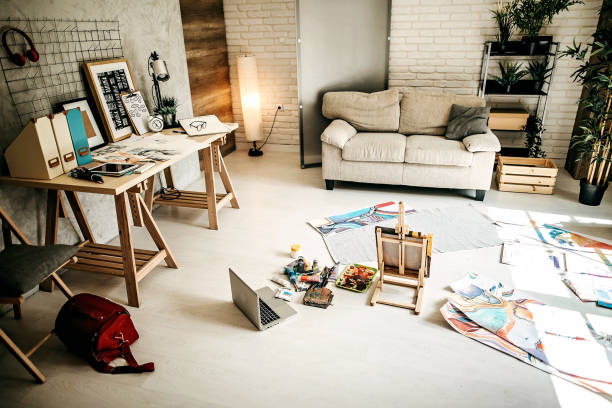
Every house has one. That awkward nook behind the stairs, the half-finished basement corner with exposed pipes, the spare bedroom that became a storage graveyard for outgrown furniture and boxes of old tax returns. You walk past it every day and never think twice. But here is the secret that professional creators have known for decades: the most powerful creative space is often the one that nobody else wants. By deliberately claiming a forgotten, ugly, or inconvenient spot and turning it into your designated creative zone, you trick your brain into treating that location differently than every other room in your home. And that difference is exactly what sparks original work.
Think about how your normal spaces function. Your kitchen is wired for feeding. Your living room is wired for relaxing or entertaining. Your home office, if you have one, is wired for meetings and spreadsheets. Those rooms carry years of accumulated habits. When you sit at your dining table to sketch, part of your mind is still expecting a plate of spaghetti. But a space that has no history, no purpose, and no emotional weight is a blank slate. Your brain sees it as undefined territory, and that uncertainty forces you to engage more actively. You cannot autopilot your way through a creative session in a room you have never used for anything before.
The practical trick is not to make the space perfect. Do not wait until you have painted the walls, installed proper lighting, and bought a designer desk. The best creative spaces are often messy, half-finished, and slightly uncomfortable. A former laundry room with a concrete floor and a single bare bulb might sound unappealing, but that rawness actually protects your focus. There are no distractions. No comfortable couch to nap on. No television to turn on. The room exists for one reason only: to make things. You enter it, and your brain understands immediately that this is not a place for scrolling social media or answering emails. It is a work-only zone, and that boundary is more valuable than any ergonomic chair.
Start by clearing the space of everything that does not belong. Remove the boxes, the old paint cans, the broken lamp you meant to fix. Then bring in only the bare essentials: a sturdy table or desk, a chair that is functional but not luxurious, a light source you can control, and the tools or materials specific to your craft. If you are a writer, that might be a laptop and a notebook. If you are a painter, a easel and a palette. If you are a musician, an instrument and a stand. Do not decorate. Do not add inspirational quotes or mood boards. The emptiness is the point. The space should feel like a workshop, not a sanctuary. You are there to labor, not to relax.
The psychology behind this is simple but powerful. When you repeatedly enter the same physical location to do creative work, your brain builds a conditioned response. Over time, the mere act of stepping into that corner triggers a state of focus and idea generation. You no longer have to fight for motivation; the space itself becomes the signal. This is why many successful artists maintain a studio separate from their living quarters, even if it is just a small shed in the backyard. The separation matters. A dedicated space, no matter how humble, tells your mind that creativity is not a random event that happens when inspiration strikes. It is a practice that takes place in a specific location, at a specific time, using a specific set of tools.
Do not underestimate the power of inconvenience. A space that is slightly difficult to reach, such as an attic accessed by a pull-down ladder or a basement corner that requires navigating storage shelves, can improve your output. Why? Because the friction of getting there forces you to commit. You will not drift in and out of the space casually. You will go there intentionally, with a plan. That small barrier weeds out half-hearted attempts and leaves only deliberate effort. And when you are already uncomfortable from the climb or the cold concrete floor, you are more likely to stay focused and get the work done rather than waste time.
The next time you walk past that neglected corner of your home, stop and look at it with fresh eyes. Do not see a problem to be solved. See an opportunity to claim a territory that belongs entirely to your creative self. Paint the walls a dull grey. Keep the single bulb. Put a folding table and a hard chair. Leave the dust. Then walk in every day, close the door, and let the emptiness do its work.
Articles