How Meditating on a Single Stone Can Unlock Your Creative Flow
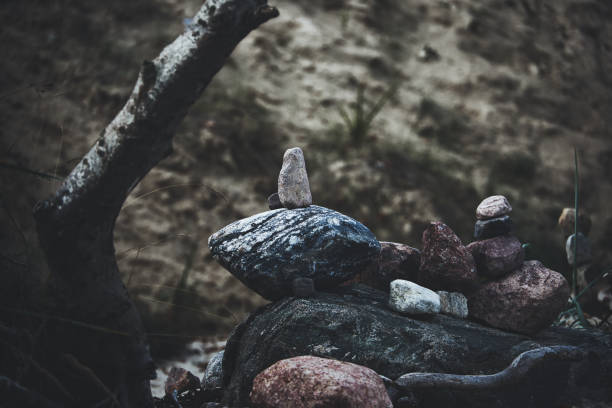
You have probably spent countless hours staring at a blank page or an empty canvas, waiting for a good idea to appear. The pressure to produce something original can freeze the mind. Yet the most reliable path to creative breakthrough is not more effort—it is a kind of disciplined laziness. The practice of focusing your attention on a single, ordinary object for a set period of time can dissolve that mental block and open the door to fresh thinking. One of the best objects to start with is a small stone you can hold in your palm.
Pick any stone from a driveway, a garden path, or a riverbank. It should be unremarkable: gray, rough, maybe a bit dusty. Sit down somewhere quiet and place the stone in your hand. For the next ten minutes, do nothing but look at that stone. Do not try to think about creativity or about your project. Do not judge the stone as boring or interesting. Just look. Notice the way light falls across its surface. Observe the tiny pits and scratches, the subtle variations in color from charcoal to ash. Run your thumb over its edge and feel the temperature, the grain, the unexpected smoothness in one spot. If your mind wanders to your to-do list or that deadline, gently bring it back to the stone. That is the entire exercise.
What does this have to do with boosting creativity? Everything. The creative class—painters, writers, designers, musicians, inventors—often believe that ideas come from thinking harder. In reality, they come from seeing differently. When you fix your attention on a single object, you train your mind to slow down and notice details that you normally overlook. Your brain is wired to scan for novelty and to categorize the world in efficient shortcuts. That stone? Your brain says “stone” and moves on. But when you force yourself to stay with it, you start to see the infinite uniqueness in that one piece of rock. This shift from looking to seeing is the foundation of original work.
Think of it as a kind of mental reset. Your daily life is filled with noise—screens, notifications, conversations, deadlines. That constant input keeps your mind in a reactive state, leaping from one thought to the next. Creativity requires a different gear: a receptive state where associations can form beneath the surface. By meditating on a single object, you quiet the chatter. You give your brain permission to stop hunting for solutions and simply observe. And in that stillness, unexpected connections begin to spark.
Consider what your stone actually is. It was formed millions of years ago from pressure and heat, or from the slow deposit of sediment. It has been tumbled by rivers, cracked by frost, heated by sun. Every scratch is a story. As you study it, you might start to wonder: How many hands have touched this stone before mine? What would it look like if I polished it? Could I use its shape as a pattern for a sculpture or a logo? That curve—does it remind me of a wave, a bone, a letter? The stone has no agenda, yet it begins to ask questions. Those questions are the seeds of creative work.
The more you practice this single-object meditation, the more your mind learns to dwell in uncertainty and curiosity. A common trap for creative people is the urge to judge ideas too early. You sit down to write and the first sentence feels terrible, so you stop. But when you meditate on a stone, there is no good or bad. There is only what is. You learn to tolerate the discomfort of not knowing, of simply being with something unfamiliar. That tolerance is exactly what you need when you are wrestling with a half-formed concept. Instead of forcing a conclusion, you learn to stay with the problem, to examine it from every angle, until a solution emerges on its own.
Writers have used similar techniques for centuries. The poet Rainer Maria Rilke advised a young poet to look at a simple thing—a tree, a flower—and let it speak. “If your daily life seems poor,“ he wrote, “do not blame it; blame yourself that you are not poet enough to call forth its riches.“ The stone is a teacher in patience. It does not change. It does not perform. It simply exists, and by existing fully in front of you, it invites you to exist fully in return. That presence is the precondition for inspiration.
Try this exercise before your next creative session. Set a timer for ten minutes. Place a single object—a stone, a leaf, a button, a candle flame—in front of you. Breathe normally. Let your eyes roam over it without rushing. Notice when your mind starts to narrate or evaluate, and simply return to the raw sensation. After the timer ends, pick up your pen or brush and begin. You might find that the first idea that comes is not original at all, but the second or third one, the one that surfaces after you have emptied your head, will carry a freshness that could not have been forced.
Creativity is not a lightning strike. It is a slow seep, a percolation that happens when you step aside and let the world speak. A stone is a small, patient word. Listen to it.