How a Hotel Lobby Can Unlock Creative Thinking
Most people assume that serious creative work requires a quiet, controlled room with everything in its proper place. They stock their home office with ergonomic chairs, noise-canceling headphones, and perfect lighting, only to find themselves staring at the same blank wall, drawing the same blank mental picture. The problem is not the room itself but the familiarity of it. When your brain has seen the same four walls for three hundred days in a row, it stops paying attention. It goes on autopilot. And autopilot is the death of original ideas. One of the simplest ways to break this mental rut is to walk into a space where you have no history, no routines, and no expectations. A hotel lobby is a perfect example of such a place.
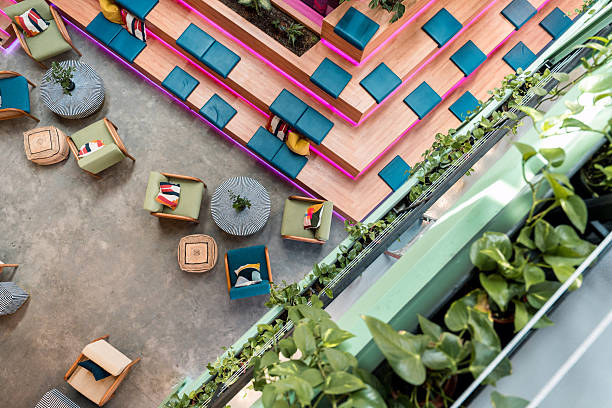
Hotel lobbies are designed to be transient. They are gathering points for people who are between destinations, carrying luggage, checking watches, and waiting for something to happen. Every person who passes through is a stranger. The furniture is arranged for convenience, not intimacy. The lighting is a mix of warm lamps and cold overhead fixtures that make everything look a little artificial. There is a constant low hum of conversation, rolling suitcases, and elevator chimes. For someone trying to do creative work, this sounds like the opposite of a productive environment. But that noise and movement are exactly what spark new thinking.
When you sit in a hotel lobby, your brain has to filter out dozens of unfamiliar stimuli. You can hear a businesswoman on the phone arguing about a contract in a language you do not understand. You see a child spinning in a revolving door. The barista at the small coffee counter calls out a name that is not yours. All of these small events demand a fraction of your attention, forcing your mind to stay alert. This mild state of distraction does not ruin your focus the way you might think. Instead, it prevents you from slipping into the deep, trance-like focus that often leads to tunnel vision. Tunnel vision is useful for executing a known task, but it is terrible for generating something new. In a lobby, your mind jumps between your work and the environment, making connections it would never make in a silent room.
The physical layout of a hotel lobby also works in your favor. Unlike a coffee shop, where you usually feel obligated to buy something every hour, a hotel lobby gives you permission to linger. You can find an armchair in a corner, spread out a notebook, and stay for two hours without anyone asking you to leave. The space is designed for waiting, and waiting is exactly what creative work requires. You are waiting for an idea to surface, for a sentence to form, for a solution to click. The neutrality of the lobby means you have no emotional attachment to the space. You do not have to clean it, decorate it, or worry about the mail piling up. All of that mental overhead disappears, freeing up energy for the work itself.
One practical trick is to choose a hotel that is not near your home. A lobby ten minutes from your apartment still feels too familiar. Walk fifteen or twenty blocks, or take a short bus ride, to a neighborhood you rarely visit. The longer you travel, the more your brain registers that you have entered a different world. This sense of distance, even if it is only forty minutes by train, triggers a shift in perspective. You become a visitor, an observer, and that observer mindset is invaluable for creative thinking. Artists and writers have long understood that travel stimulates the imagination, but you do not need a plane ticket. You just need a lobby with a different carpet and a different smell.
Another advantage is the lack of digital distraction. Most hotel lobbies have weak Wi-Fi or require a room key for the password. Without instant access to your usual stream of notifications, you are forced to work offline. You can write by hand, sketch ideas, or read a physical book. This disconnect from the internet reduces the temptation to check email every five minutes. It also slows down your thinking. When you write longhand, your brain has to process each word more deliberately. The result is often more original and less formulaic than typing.
Of course, not every hotel lobby will work. Avoid the ones near convention centers during peak hours, when the noise becomes overwhelming. Look for a boutique hotel with a lounge area that feels slightly empty. The goal is to have enough background activity to keep your brain engaged, but not so much that you cannot hear yourself think. If you are sensitive to sound, a pair of simple foam earplugs can cut the noise without isolating you completely. You still want to be aware of the room, just not drowning in it.
The most important thing is to treat the lobby as a workspace, not a coffee run. Bring everything you need before you sit down. A notebook, a pen, a charged laptop if you must, and a water bottle. Order one coffee if you like, but do not make the barista your focus. The moment you start fidgeting with your phone or scanning the room for something interesting to watch, the magic fades. You are there to do work, not to people-watch. But because the environment is alive, the work itself becomes alive.
Try it for one afternoon. Pick a hotel you have never entered, walk in like you belong there, find a chair, and start something. It does not have to be a masterpiece. It just has to be different from what you would have done at your desk. The change in environment forces a change in thinking. And that is the whole point.
Articles